Sometimes the first sign of financial abuse is not missing money. It is something that suddenly feels unlike the person you know.
Your mother, who has paid every bill on time for 30 years, suddenly has an overdue notice.
Your father becomes unusually private when you ask about a large withdrawal.
A new friend starts attending financial appointments.
Or a caregiver who was hired to help with daily tasks is now handling banking, cards, passwords, or financial decisions.
None of these automatically means financial abuse is happening.
But they are worth noticing.
For families, one of the most useful ways to recognize elder financial abuse signs is not simply to look for fraud.
Look for a change in the person's normal pattern.
Why This Conversation Matters More in 2026
The financial environment surrounding older Americans is changing quickly.
According to the FBI's 2025 Internet Crime Report, people age 60 and older filed 201,266 complaints involving reported losses of approximately $7.75 billion.
That was a 59% increase in reported losses from 2024.
The average reported loss exceeded $38,500, and more than 12,400 people over 60 reported losing at least $100,000.
Those figures cover internet crime reported to the FBI. They do not represent every form of elder financial abuse.
But they tell families something important:
The financial risks surrounding older adults are becoming harder to dismiss as occasional or isolated events.
And technology is adding another layer. Today's fraud environment can include investment schemes, impersonation, tech-support scams, cryptocurrency, romance scams, AI voice cloning, and even “recovery scams” that approach someone after they have already lost money.
That makes family awareness increasingly important.
Financial Abuse Is Not Always a Stranger Calling
When people hear “elder fraud,” they often picture an unknown scammer on the phone.
But financial exploitation of elderly adults can also involve someone the person knows.
It might be a relative misusing account access. A caregiver pressuring someone for gifts. A new acquaintance gradually becoming involved in financial decisions. Or someone using a power of attorney for their own benefit.
That is why caregiver financial abuse and exploitation inside trusted relationships can be particularly difficult to recognize.
The question is not only:
“Was this transaction a scam?”
A better question may be:
“Is this consistent with how Mom or Dad normally manages money and makes decisions?”
The Pattern Break: What Changed?
The Consumer Financial Protection Bureau identifies warning signs including unexplained withdrawals, unusually frequent ATM use, unpaid bills, unfamiliar people being added to accounts, unexpected gifts, beneficiary changes, missing financial statements, and another person suddenly beginning to manage someone's money.
Individually, any one of these may have a reasonable explanation.
Together, they may tell a different story.
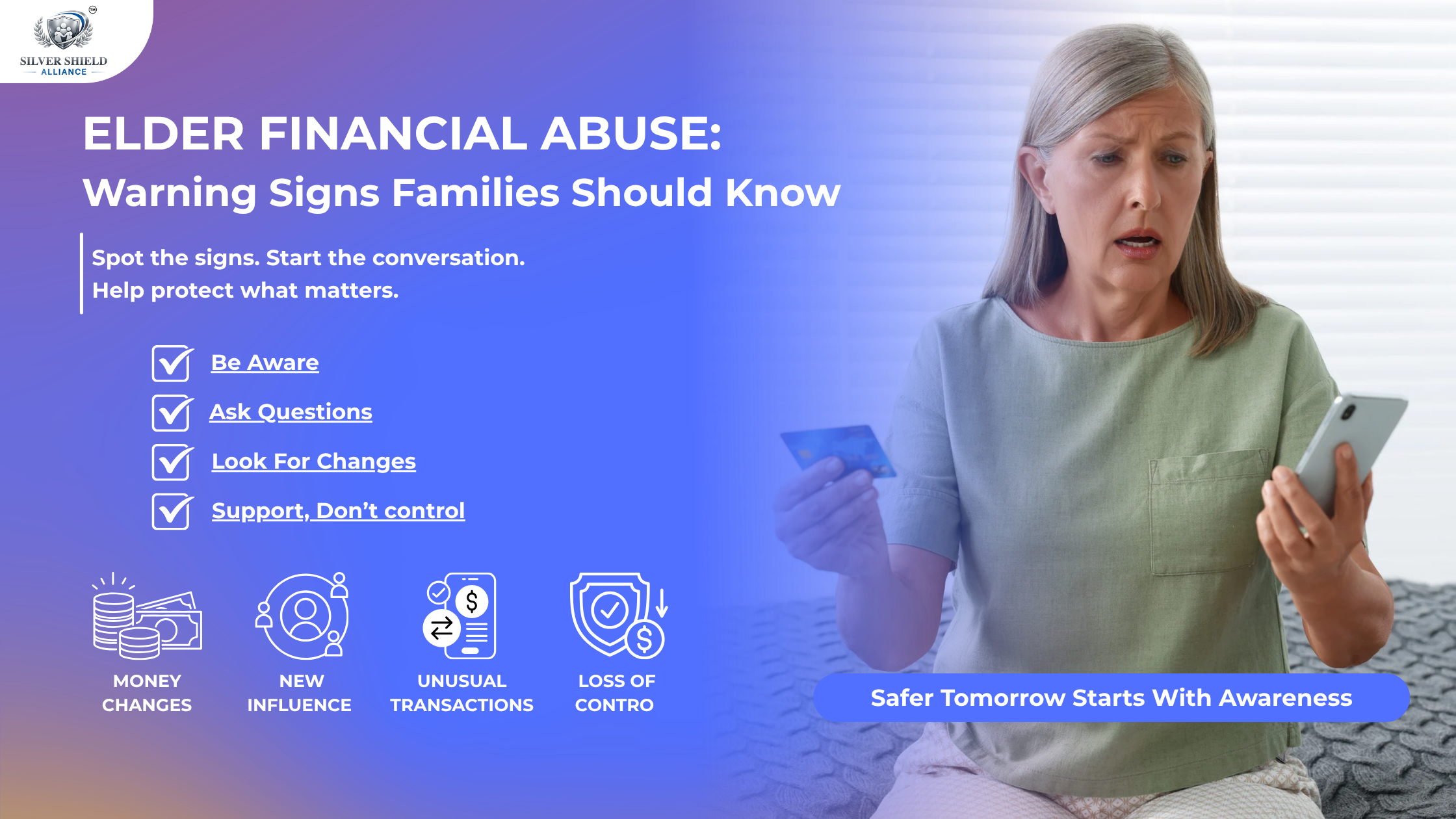
Families can make the signs easier to remember by looking at three areas:
1. MONEY: Has the Financial Pattern Changed?
Watch for:
- unusual withdrawals or transfers
- bills suddenly going unpaid
- unexplained purchases or new subscriptions
- frequent or expensive gifts
- unfamiliar account activity
- unexpected changes to beneficiaries, wills, property, or financial accounts
The goal is not to inspect every purchase.
It is to notice activity that seems out of character.
2. RELATIONSHIPS: Has Someone's Influence Changed?
Pay attention when a new or existing person suddenly becomes heavily involved in financial matters.
That could include a friend, relative, caregiver, professional, or new romantic interest.
A bigger concern is when that involvement comes with secrecy or isolation.
For example, someone insists on being present during conversations, discourages family visits, speaks for the older adult, or makes it difficult to talk privately.
3. CONTROL: Who Is Making the Decisions?
This may be the most overlooked question.
Has someone started taking over banking?
Are passwords, cards, checks, or account statements now controlled by another person?
Does your loved one understand recent financial changes?
Most importantly:
Do they still seem comfortable making their own decisions?
Helping an older family member with money should support independence, not quietly replace it.
How to Ask Without Taking Over
Finding a possible warning sign does not mean starting an interrogation.
Imagine being asked:
“Why did you send that money?”
“You can't manage this anymore.”
“Give me access to your account.”
Even when those words come from concern, they can feel like a loss of independence.
Instead, try beginning with what you noticed:
“I saw that this bill hasn't been paid like it normally is. Is everything okay?”
Or:
“This seems different from what you usually do. Would you like me to look at it with you?”
That small shift matters.
It keeps the older adult involved in the conversation instead of turning them into the subject of an investigation.
If Something Still Doesn't Add Up
Start by documenting what you have noticed: dates, transactions, names, messages, calls, or changes in behavior.
If a bank, credit card, or financial account may be involved, contact the financial institution promptly. The CFPB also recommends contacting Adult Protective Services when elder financial exploitation is suspected. Immediate danger should be reported to 911.
And remember that people who have already experienced fraud can sometimes be targeted again. “Recovery” scams may promise to retrieve lost money while asking for another payment or financial information.
So be careful about anyone promising a quick recovery for an upfront fee.
Financial Safety Should Protect Independence, Too
Families do not need to monitor every dollar an older loved one spends.
They need better conversations, stronger awareness, and a shared understanding of what “normal” looks like.
That is also why education matters before a crisis happens.
At Silver Shield Alliance, our approach to scam prevention and digital safety is built around helping older adults and families understand changing risks while continuing to use technology and manage everyday life with confidence.
Protection should not mean taking independence away. It should make independence safer.
Explore Silver Shield Alliance's safety, scam prevention, and technology education programs to learn how practical education can help older adults and families build stronger digital and financial safety habits.